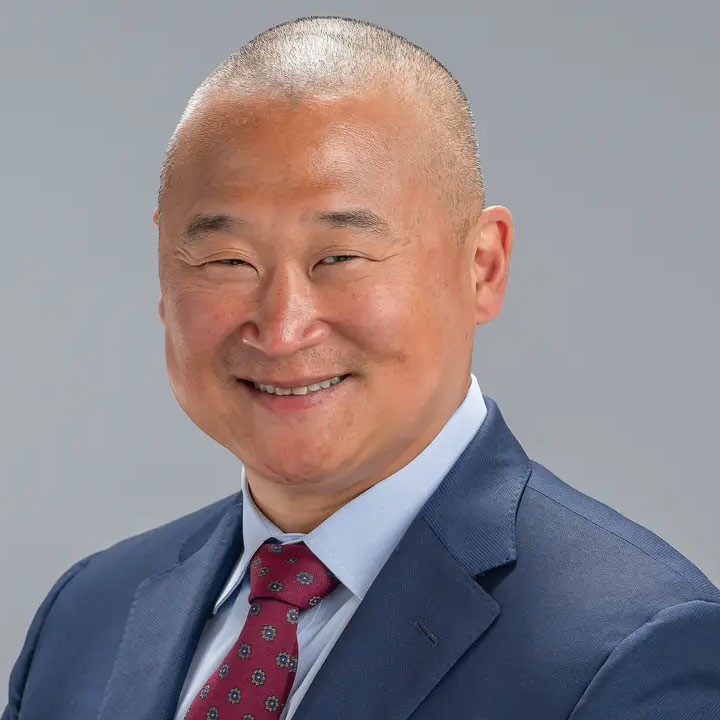
Simon Peter Kim, M.D., M.P.H.
Dr. Kim is a physician-scientist, urologic oncologist, and nationally recognized leader in health services research and outcomes research focused on prostate, kidney, and bladder cancers. With deep expertise in patient-centered decision-making, disparities in care, quality improvement, and the implementation of evidence-based practices, he has built a distinguished career bridging rigorous research with real-world clinical impact. His work has been published in more than 200 peer-reviewed articles in leading journals including the Journal of Urology, European Urology, Cancer, BJU International, JAMA Internal Medicine, and Annals of Surgical Oncology.
Dr. Kim’s expertise in developing decision aids and shared decision-making tools, advancing active surveillance strategies, addressing racial and socioeconomic disparities in access to robotic surgery and advanced treatments, and improving surgical quality and outcomes aligns directly with the mission of the Breakthrough Treatment Center—to accelerate access to cutting-edge therapies and novel clinical trials for patients facing difficult-to-treat cancers. His proven experience building investigator-led research programs, directing robotic surgery and cancer programs, leading quality and safety initiatives, and fostering multidisciplinary collaboration will play a pivotal role in expanding the Center’s impact in urologic oncology and creating new opportunities for innovation and hope for patients across the region and beyond.
Before joining OSF HealthCare, Dr. Kim served as Professor in the Division of Urology at the University of Colorado Denver (2022–2024), where he also held roles as Associate Residency Program Director, Site Director for University of Colorado Hospital, member of the Promotion Committee and Surgical Quality Improvement and Safety Committee, and Cancer Center Member. He previously served as Associate Professor at Case Western Reserve University School of Medicine (2017–2019), with directorships in Robotic Surgery and Kidney and Bladder Cancer at University Hospitals Cleveland Medical Center, and as Assistant Professor at Yale University. His foundational training included urology residency at the University of Michigan and urologic oncology fellowship at Mayo Clinic, where he also completed a research scholarship in healthcare delivery and research.
Dr. Kim’s research portfolio encompasses national trends and barriers to active surveillance for prostate cancer, development and implementation of decision aids for shared decision-making, disparities in treatment access and outcomes, comparative effectiveness of surgical approaches (including partial vs. radical nephrectomy and robotic techniques), quality metrics, costs, complications, and survivorship after major urologic cancer surgeries (radical cystectomy, prostatectomy, nephrectomy), clinical prediction tools and nomograms, and emerging applications of artificial intelligence and deep learning in prostate cancer. He currently leads a Schramm Foundation-funded project on deep learning and artificial intelligence for prostate cancer and has served as principal investigator or co-investigator on NIH R01, Conquer Cancer Foundation, and other major grants focused on decision support and prostate cancer care.
In addition to his role at OSF, Dr. Kim serves as Visiting Professor of Urologic Oncology and Urology at OSF HealthCare and the University of Illinois College of Medicine Peoria. He will collaborate closely with researchers across the University of Illinois system and regional partners to advance translational research, investigator-initiated clinical trials, investigator training, and high-impact programs in urologic oncology.
Research Areas of Interest
- Outcomes research, health services research, and quality improvement in prostate, kidney, and bladder cancer
- Shared decision-making, decision aids, and patient-centered communication in urologic oncology
- Disparities in cancer care access, treatment utilization (including robotic surgery), and clinical outcomes
- Active surveillance for low- and intermediate-risk prostate cancer: national trends, barriers to adoption, and implementation strategies
- Comparative effectiveness, perioperative outcomes, costs, and survivorship following surgical management of urologic cancers
- Development and validation of clinical prediction models, nomograms, and risk stratification tools
- Applications of artificial intelligence and deep learning in prostate cancer detection, risk assessment, and management
- Building investigator-initiated clinical trials, translational research programs, and multidisciplinary collaboration in urologic oncology
Education & Training
- B.A. — University of Rochester, Rochester, New York (1991–1995)
- M.P.H. — University of Illinois at Chicago, Chicago, Illinois (1995–1997)
- M.D. — Chicago Medical School, North Chicago, Illinois (2000–2004)
- Research Analyst — Northwestern University, Chicago, Illinois (1997–1999)
- Urology Residency — University of Michigan, Ann Arbor, Michigan (2004–2010)
- Research Scholar, Healthcare Delivery and Research Program — Mayo Clinic, Rochester, Minnesota (2010–2012)
- Urologic Oncology Fellowship / Clinical Instructor in Urology — Mayo Clinic, Rochester, Minnesota (2010–2013)
Board Certifications & Professional Memberships
- Board Certified, American Board of Urology (ABU), 2016
- Board Certified / Fellowship Trained, Society of Urologic Oncology (SUO), 2013
- Diplomat, American Urological Association (AUA)
- Member, Society of Urologic Oncology (SUO)
- Member, American College of Surgeons
- Member, European Association of Urology (EAU)
- Member, Society of Academic Urology
- Extensive national leadership and editorial roles, including Associate Editor for Outcomes Research (AUA News), Editorial Board (Journal of Urology), Section Editor for Urologic Oncology (Annals of Surgical Oncology), grant reviewer (NCI, AUA), and multiple AUA committees and workgroups
Selected Publications
Representative examples highlighting his contributions (full bibliography exceeds 200 peer-reviewed articles):
- Kim SP, et al. Perceptions of active surveillance and treatment recommendations for low-risk prostate cancer: Results from a national survey of radiation oncologists and urologists. Med Care. 2014.
- Kim SP, et al. Disparities in access to hospitals with robotic surgery for prostate cancer patients undergoing radical prostatectomy. J Urol. 2013.
- Weight CJ, Kim SP, et al. Routine adrenalectomy in patients with locally advanced renal cell cancer does not offer oncologic benefit… Eur Urol. 2011.
- Kim SP, et al. Contemporary trends in nephrectomy for renal cell carcinoma in the United States… J Urol. 2011.
- Kim SP, et al. The implications of hospital-acquired adverse events on in-hospital mortality, length of stay and costs for patients undergoing radical cystectomy… J Urol. 2012.
- Multiple national survey and implementation studies on decision aids, shared decision-making, and barriers to active surveillance (supported by NIH R01 and Conquer Cancer Foundation awards).
- Extensive body of work on quality of care, complications, urinary diversion trends, and outcomes after radical cystectomy and prostatectomy (published in J Urol, BJU Int, Eur Urol, Cancer).
- Emerging work on AI/deep learning applications in prostate cancer (current Schramm Foundation project).
Dr. Kim brings a unique combination of surgical expertise, deep outcomes research experience, and a passion for patient-centered, equitable, and high-quality cancer care. His arrival strengthens OSF HealthCare’s capacity to deliver breakthrough treatments and investigator-driven innovation in urologic oncology.