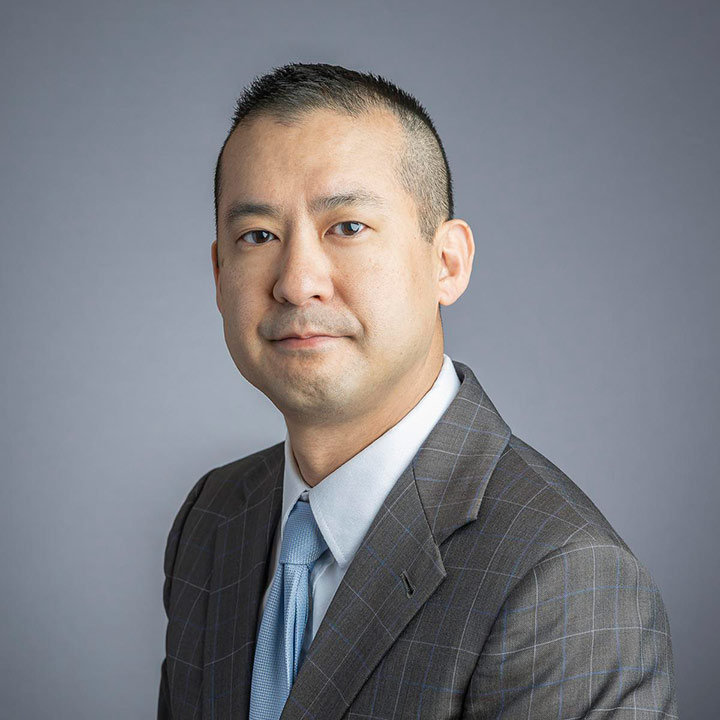
Andrew J. Tsung, MD
Neurosurgical Oncology | Translational Neuro-Oncology | Metabolic Therapeutics
Andrew Tsung, MD, MBA, FAANS, is a physician-scientist and neurosurgical oncologist at OSF HealthCare. He serves as vice president of OSF HealthCare Illinois Neurological Institute (INI), where he leads the neurosurgery, neurology and physiatry divisions in strategic growth initiatives and daily operations. Dr. Tsung also serves as the Patrick Elwood Endowed Chair in the Department of Neurosurgery at the University of Illinois College of Medicine, and as program director of the University of Illinois College of Medicine at Peoria (UICOMP) Department of Neurosurgery Residency Program. In addition, he is codirector of the Molecular Translational Oncology Laboratory at UICOMP alongside Kiran Velpula, PhD.
Dr. Tsung earned his medical degree from Southern Illinois University School of Medicine, graduating with Alpha Omega Alpha (AΩA) honors. He completed his neurosurgery residency at UICOMP and subsequently pursued fellowship training in neurosurgical oncology at The University of Texas MD Anderson Cancer Center under the mentorship of pioneering neuro-oncologic surgeon Raymond Sawaya, MD. He later returned to the University of Illinois to complete an MBA focused on business analytics, aligning clinical and research strategy with the broader objectives of UICOMP and INI. To further support his research, he is also completing a Master of Science in Applied Physics at Johns Hopkins University.
Dr. Tsung’s research integrates metabolic therapeutics for high-grade glioma with the physical principles underlying cellular division. In the Molecular Translational Oncology Laboratory at UICOMP, his team studies metabolic checkpoints that regulate how cancer cells use and dissipate energy during cell division. High-grade gliomas often exploit adaptive metabolic bypass pathways to sustain growth and proliferation, and these mechanisms represent key therapeutic targets under investigation by Dr. Tsung and his team. This work has led to multiple research grants, peer-reviewed publications and a patent-pending therapeutic strategy involving 3-Phosphoinositide-dependent kinase 1 (PDK1) inhibitors for the treatment of glioblastoma.
Selected Publications
- Hanmer, J., Arnold, J., Hall, A., Ratcliff, J. J., Allen, J. W., Frankel, M., Wright, D. W., Barrow, D. L., Pradilla, G., Smith, K. J., and ENRICH Trial Investigators. (2025). Cost-effectiveness analysis of early minimally invasive removal of intracerebral hemorrhage. Stroke, 56(7), 1799–1806. https://doi.org/10.1161/STROKEAHA.124.048493
- Winslow, N., Boyle, J., Miller, W., Wang, Y., Geoffroy, F., and Tsung, A. J. (2024). Development of brain metastases in non-small-cell lung cancer: High-risk features. CNS Oncology, 13(1), 2395804. https://doi.org/10.1080/20450907.2024.2395804on page 7
- Pradilla, G., Ratcliff, J. J., Hall, A. J., Saville, B. R., Allen, J. W., Paulon, G., McGlothlin, A., Lewis, R. J., Fitzgerald, M., Caveney, A. F., Li, X. T., Bain, M., Gomes, J., Jankowitz, B., Zenonos, G., Molyneaux, B. J., Davies, J., Siddiqui, A., Chicoine, M. R., Keyrouz, S. G., Grossberg, J. A., Shah, M. V., Singh, R., Bohnstedt, B. N., Frankel, M., Wright, D. W., & Barrow, D. L. (2024). Trial of early minimally invasive removal of intracerebral hemorrhage. New England Journal of Medicine, 390(14), 1277–1289. https://doi.org/10.1056/NEJMoa2308440
- Elliott, W., Jr., Tsung, A. J., Guda, M. R., and Velpula, K. K. (2024). Galectin inhibitors and nanoparticles as a novel therapeutic strategy for glioblastoma multiforme. American Journal of Cancer Research, 14(2), 774–795.
- Jalasutram, A., Caniglia, J. L., Velpula, K. K., Guda, M. R., Bach, S. E., and Tsung, A. J. (2022). TERT expression increases with tumor grade in a cohort of IDH-mutant gliomas. American Journal of Translational Research, 14(1), 295–303.
- Guda, M. R., Velpula, K. K., Asuthkar, S., Cain, C. P., and Tsung, A. J. (2020). Targeting RGS4 ablates glioblastoma proliferation. International Journal of Molecular Sciences, 21(9), Article 3300. https://doi.org/10.3390/ijms21093300
- Tsung, A. J., Guda, M. R., Asuthkar, S., Labak, C. M., Purvis, I. J., Lu, Y., Jain, N., Bach, S. E., Prasad, D. V. R., and Velpula, K. K. (2017). Methylation regulates HEY1 expression in glioblastoma. Oncotarget, 8(27), 44398–44409. https://doi.org/10.18632/oncotarget.17897
- Ferguson, S. D., Levine, N. B., Suki, D., Tsung, A. J., Lang, F. F., Sawaya, R., Weinberg, J. S., and McCutcheon, I. E. (2018). The surgical treatment of tumors of the fourth ventricle: A single-institution experience. Journal of Neurosurgery, 128(2), 339–351. https://doi.org/10.3171/2016.11.JNS161167
- Alvarado, A. G., Turaga, S. M., Sathyan, P., Mulkearns-Hubert, E. E., Otvos, B., Silver, D. J., Hale, J. S., Flavahan, W. A., Zinn, P. O., Sinyuk, M., Li, M., Guda, M. R., Velpula, K. K., Tsung, A. J., Nakano, I., Vogelbaum, M. A., Majumder, S., Rich, J. N., & Lathia, J. D. (2016). Coordination of self-renewal in glioblastoma by integration of adhesion and microRNA signaling. Neuro-Oncology, 18(5), 656–666. https://doi.org/10.1093/neuonc/nov196
- Velpula, K. K., Bhasin, A., Asuthkar, S., and Tsung, A. J. (2013). Combined targeting of PDK1 and EGFR triggers regression of glioblastoma by reversing the Warburg effect. Cancer Research, 73(24), 7277–7289. https://doi.org/10.1158/0008-5472.CAN-13-1868
View Full List of Publications
View a complete list of Dr. Tsung’s published work on PubMed.
OSF HealthCare Provider Profile
View Dr. Tsung’s provider profile.