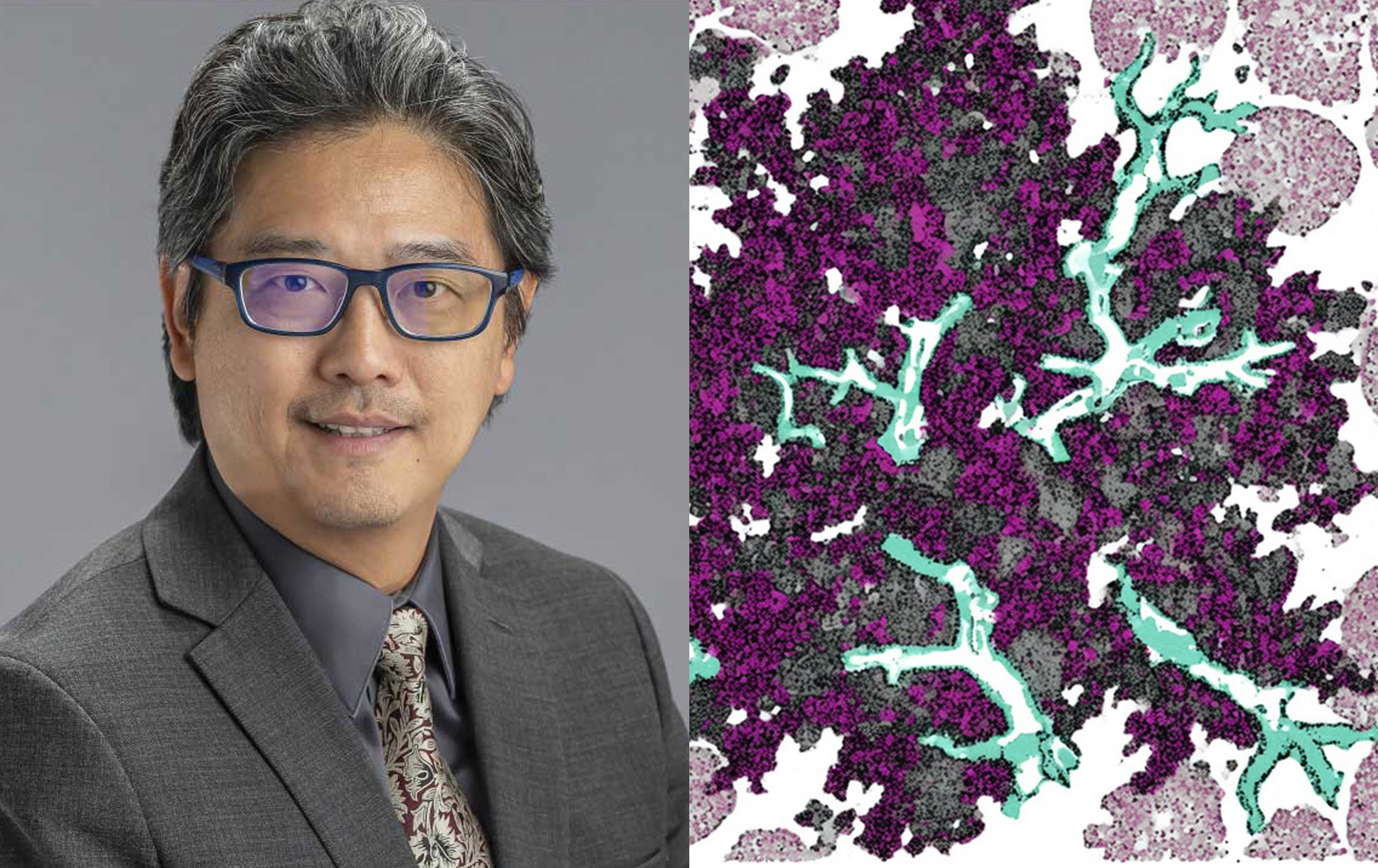
Jun Zhang, MD, PhD, Vice President of Oncology Research at OSF HealthCare Cancer Institute, delivered an oral presentation at the 2026 American Society of Clinical Oncology (ASCO) Annual Meeting, held May 29–June 2 in Chicago. His work demonstrated how a centralized navigation model combined with AI-assisted alerts dramatically improved lung cancer screening rates and early detection across a large health system.
The American Society of Clinical Oncology (ASCO) is the world’s leading professional organization dedicated to advancing cancer research and improving patient care. Its Annual Meeting serves as the premier international forum where thousands of oncology professionals gather to present and discuss the latest findings from clinical trials and translational studies.
Dr. Zhang presented results from a 6-year analysis (2019–2025) of a centralized, technology-enabled lung cancer screening program across OSF HealthCare’s 16-hospital system. The model centralized patient navigation to manage screening registries and scheduling while using AI-assisted electronic health record alerts to identify eligible high-risk patients. System-wide screening rates rose from 18.2% in 2020 to 42.8% in 2025 — significantly outperforming the projected 2025 U.S. national average (19.5%) and Illinois state average (20.8%). Absolute screening volume nearly doubled, increasing from 2,257 scans in 2019 to 4,108 in 2025. The program proved highly resilient during the COVID-19 pandemic, maintaining 98.5% of prior-year volume while national screening declined by 5%. Early-stage (Stage I) detection improved while late stage (Stage IV) diagnosis decreased steadily, with the largest benefit seen in rural facilities. This centralized, AI-supported navigation model provides a scalable blueprint for improving early lung cancer detection and addressing rural health inequities.
In practical terms, this study shows that a centralized team of navigators supported by smart AI technologies can more than double lung cancer screening rates across a large health system — including in rural areas that traditionally lag behind. By removing the burden from busy primary care offices and using technology to find eligible patients, the program caught more cancers at earlier, more treatable stages. These real-world results demonstrate that a centralized, AI-supported navigation model can substantially increase lung cancer screening rates and improve early detection, including in rural settings. This approach may serve as a useful model for other health systems seeking to improve screening uptake.
Suggested reading: https://ascoai.org/articles/2026/06/ai-assisted-multistep-lung-cancer-screening-program-boosts-uptake-beyond-national-averages/.
In addition, Dr. Zhang delivered a poster presentation on exploratory biomarker analysis from the AdvanTIG-105 study, evaluating the combination of ociperlimab (an investigational anti-TIGIT antibody) plus tislelizumab (an anti-PD-1 antibody) in patients with PD-L1–positive non–small cell lung cancer (NSCLC). The analysis explored potential biomarkers associated with treatment outcomes and observed trends toward longer progression-free survival and higher response rates in certain biomarker-defined subgroups. These findings are exploratory and require validation in prospective trials.
Dr. Zhang was also the first author of a publication-only abstract titled “Nanoscale spatial profiling of DLL3, SEZ6, and B7-H3 in small cell lung cancer using a rapid expansion microscopy assay.” This work applied advanced high-resolution expansion microscopy techniques to map the spatial distribution of three promising therapeutic targets in small cell lung cancer (SCLC), providing new insights that could help guide future targeted therapy development.
Finally, he was also a co-author for an ongoing phase 1 study using intratumoral injection of tolododekin alfa (ANK-101) in NSCLC and a phase 3 study using ZL-1310 in SCLC patients.
“These contributions reflect our team’s commitment to both improving current care delivery and advancing the science that will shape tomorrow’s treatments,” said Dr. Zhang.
Dr. Zhang recently joined OSF HealthCare Cancer Institute to lead oncology research efforts, with a focus on translational science, clinical trials, and innovative models that expand access to high-quality cancer care.
This participation highlights OSF HealthCare Cancer Institute’s commitment to contributing to the broader advancement of cancer research and care delivery.